
What Is a Prong Collar for Dogs
A prong collar for dogs is a training collar designed with metal links that have inward-facing prongs. It works by applying even pressure around a dog’s neck when tension is applied to the leash, mimicking the natural corrective pressure a mother dog uses with her puppies.
Prong collars are primarily used for training strong pullers or dogs with leash-reactive behavior. However, they must be used properly and responsibly to avoid discomfort or harm.
Now let’s go deeper.
What Is a Prong Collar For Dogs and How Does It Work?
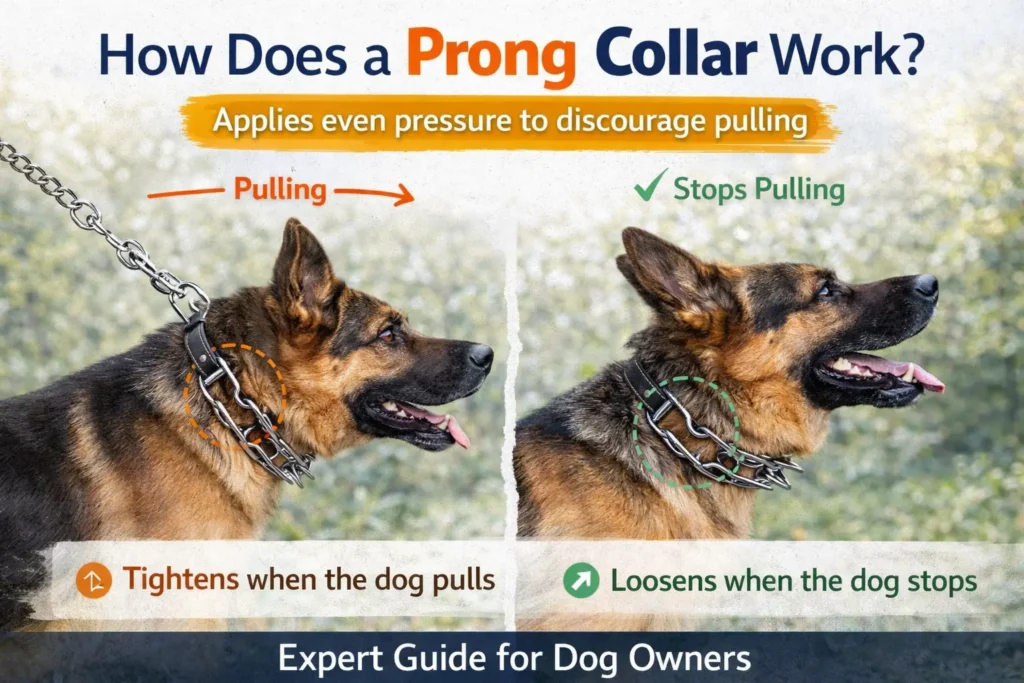
A prong collar (also called a pinch collar) is made of interlocking metal links with rounded prongs that face inward toward the dog’s neck.
Unlike a flat collar that tightens from one direction, a prong collar distributes pressure evenly around the neck when the leash is pulled.
How It Works
When the dog pulls:
- The collar tightens slightly
- The prongs apply gentle pressure evenly
- The dog feels discomfort (not pain if used correctly)
- The dog learns to stop pulling
When the dog stops pulling:
- Pressure immediately releases
- The collar loosens
- The dog feels comfort again
This “pressure and release” principle is the foundation of many training techniques.
However, this tool is meant for controlled training situations — not for everyday casual wear.
If you’re unsure what type of collar is right overall, read our complete guide:
How to choose the right dog collar
When Is a Prong Collar Used?
Prong collars are typically used for:
- Large, powerful dogs
- Dogs that aggressively pull on leash
- Reactive dogs
- Training sessions under supervision
- Behavioral correction programs
They are not recommended for:
- Puppies
- Small breeds
- Sensitive dogs
- Daily all-day wear
- Untrained owners without guidance
If you have a puppy, first read:
Puppy dog collar guide
Puppies require soft, adjustable collars — not corrective tools.
Are Prong Collars Safe for Dogs?
This is one of the most searched questions.
The answer depends on how they are used.
Safe When:
- Proper size selected
- Correctly positioned high on the neck
- Used under training supervision
- Not over-tightened
- Used for short training sessions
Unsafe When:
- Worn for long hours
- Used incorrectly
- Left on unsupervised
- Used on small or fragile dogs
- Used aggressively
Improper use can lead to:
- Skin irritation
- Neck injuries
- Stress behavior
- Fear-based responses
Because of these risks, many owners prefer safer, long-term solutions like a high-quality leather dog collar:
Prong Collar vs Regular Dog Collar
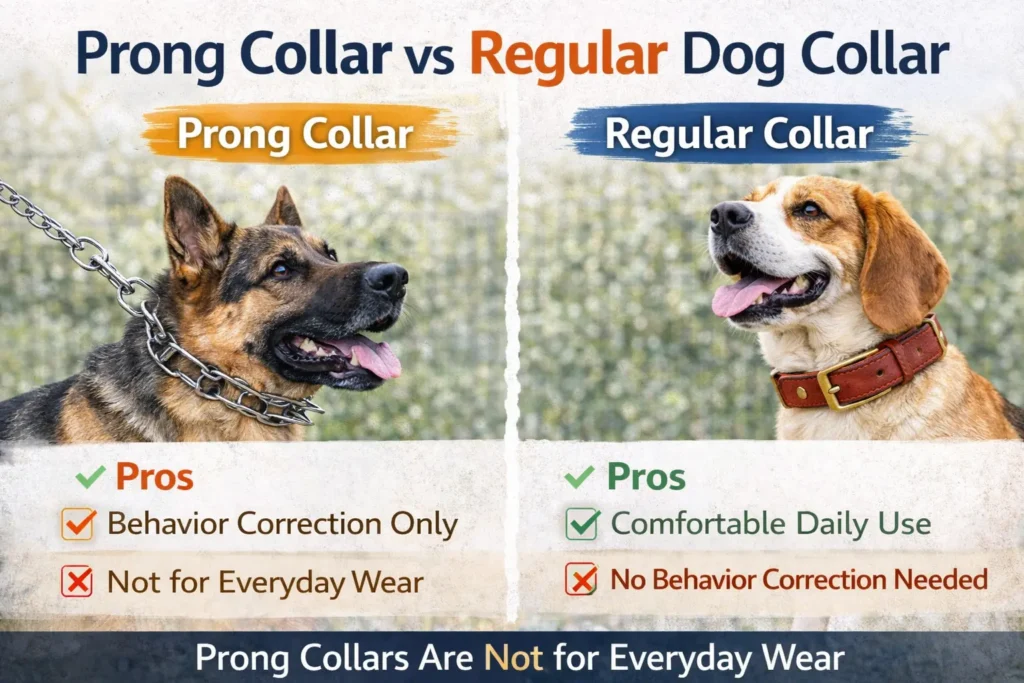
Let’s compare.
Flat Collar (Standard Collar)
A standard collar:
- Sits comfortably around the neck
- Used for ID tags
- Used for everyday walking
- Made from leather or nylon
If you want to understand material differences, read:
Leather vs nylon dog collar
Flat collars are designed for comfort and daily use.
Prong Collar
- Used mainly for correction
- Designed for training
- Not suitable for permanent wear
- Requires skill to use properly
For most dog owners, a soft leather dog collar provides comfort and durability without harsh correction:
Do Professional Trainers Recommend Prong Collars?
Some professional trainers use prong collars in structured training programs, especially for:
- Strong working breeds
- Large dogs with leash aggression
- High-drive dogs
However, many modern trainers now prefer:
- Positive reinforcement training
- Harness-based control
- Gentle leader systems
- Reward-based behavior correction
The dog training world is evolving toward less force-based methods.
For everyday control, especially in family environments, durable leather collars remain a popular and safer choice.
Can Prong Collars Cause Damage?
If misused — yes.
Possible risks include:
- Puncture wounds (if extremely misused)
- Bruising
- Trachea damage
- Increased anxiety
- Fear-based aggression
Most injuries occur due to:
- Incorrect sizing
- Overcorrection
- Leaving collar on all day
- Unsupervised use
This is why prong collars are considered advanced tools.
For daily safety and comfort, many owners switch to premium options like:
- Black leather dog collar
- Soft padded leather collar
- Personalized engraved collar
Leather collars are strong enough for large breeds while maintaining comfort.
Are Prong Collars Better Than Leather Collars?
They serve different purposes.
| Feature | Prong Collar | Leather Collar |
|---|---|---|
| Training Correction | Yes | No |
| Everyday Wear | No | Yes |
| Comfort | Moderate | High |
| Durability | High | Very High |
| Safety for Daily Use | Not Ideal | Ideal |
A prong collar is a temporary tool.
A leather collar is a long-term investment.
If you already own a leather collar, make sure you maintain it properly:
How to clean a leather dog collar
Proper care extends lifespan and ensures comfort.
What Is the Best Alternative to a Prong Collar?
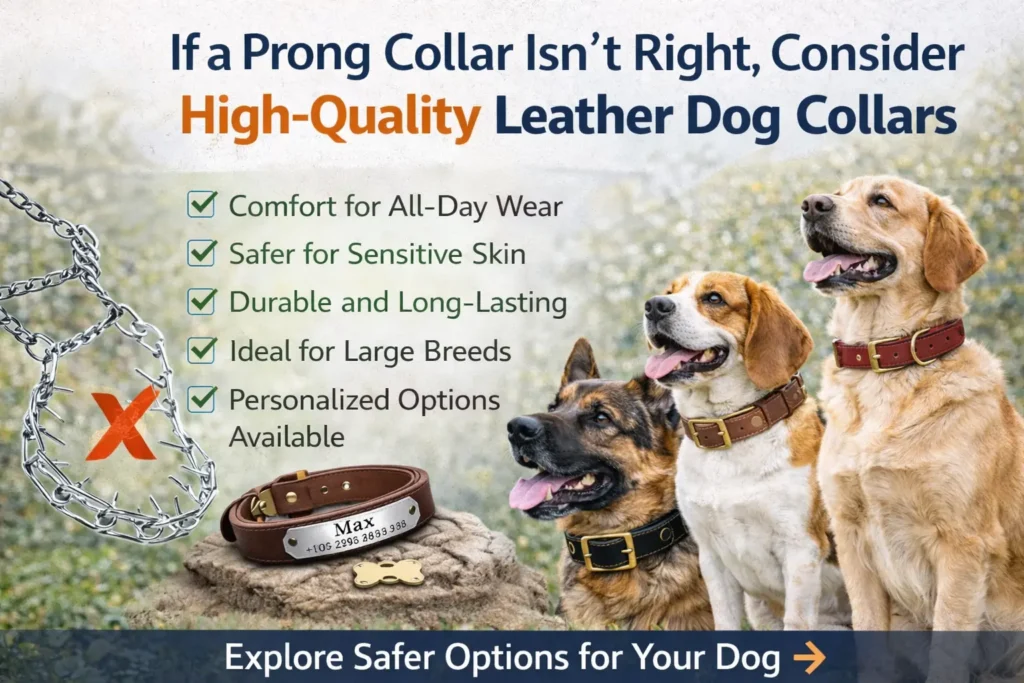
If you’re looking for safer alternatives:
1. High-Quality Leather Collar
A high-quality leather dog collar is one of the safest and most reliable alternatives to corrective tools like prong collars. Genuine leather is naturally strong, flexible, and designed to last for years with proper care.
Unlike thin synthetic materials, premium leather collars:
- Distribute pressure evenly across the neck
- Do not dig into the skin during leash tension
- Become softer over time
- Resist fraying or tearing
- Provide excellent control for strong breeds
Leather is especially ideal for medium and large dogs because it combines durability with comfort. As the material molds to your dog’s neck shape, it reduces friction and irritation, making it perfect for everyday wear.
If you’re looking for a long-term solution that balances strength and comfort, explore our full collection here:
2. Soft Leather Dog Collar
A soft leather dog collar is specially designed for dogs with sensitive skin, thin fur, or irritation issues caused by rough materials.
Unlike nylon collars that can cause rubbing and hair loss over time, soft leather:
- Feels smooth against the skin
- Reduces friction during walks
- Minimizes risk of redness or fur damage
- Adapts naturally to neck movement
- Provides gentle yet secure control
This type of collar is ideal for:
- Puppies transitioning to stronger collars
- Dogs with sensitive skin
- Small and medium breeds
- Dogs who wear collars for long hours
The flexibility of soft leather allows your dog to move comfortably without feeling restricted, making it a much safer daily-wear option compared to training-specific collars like prong collars.
If comfort is your top priority, check out:
3. Personalized Collar with Strong Buckle
A personalized dog collar with a strong buckle offers both safety and style in one smart solution.
Instead of relying on hanging ID tags that can fall off or break, a personalized collar includes engraved nameplates or stitched information directly onto the collar.
Key benefits include:
- Immediate identification if your dog gets lost
- No noisy dangling tags
- Reduced risk of tag detachment
- Cleaner and more elegant look
- Strong metal buckle for secure fastening
A reinforced buckle ensures the collar stays secure even for strong pullers, while the personalization adds an extra layer of protection.
This type of collar is especially useful for:
- Active outdoor dogs
- Large breeds
- Families in busy neighborhoods
- Travel situations
Explore personalized options here:
Should You Use a Prong Collar on a Puppy?
Absolutely not.
Puppies have:
- Fragile neck structure
- Developing bones
- Sensitive skin
- Learning-stage behavior
Instead, read our puppy collar sizing guide:
What Size collar for puppy
Choose lightweight, adjustable collars for growing dogs.
How to Properly Fit a Prong Collar (If Used)
If a professional trainer recommends one:
- It should sit high on the neck
- Fit snugly (not dangling)
- Remove unused links for correct fit
- Never hang loose like a necklace
- Never leave it on unsupervised
It should not:
- Slide down to shoulders
- Be worn all day
- Be used as punishment
Training tools require skill and patience.
Final Thoughts: Is a Prong Collar Right for Your Dog?
A prong collar is a specialized training tool designed for leash correction in strong dogs. It is not meant for casual wear or inexperienced handling.
Before choosing one, ask yourself:
- Is my dog properly trained?
- Have I tried positive reinforcement?
- Am I working with a trainer?
- Is my dog large and difficult to control?
- Am I using it short-term?
For most pet owners, a high-quality leather dog collar provides:
✔ Comfort
✔ Durability
✔ Long-term safety
✔ Style
✔ Control
Explore premium options here:
Leather dog collar

Frequently Asked Questions About Prong Collars for Dogs
1. What is a prong collar used for in dogs?
A prong collar is primarily used as a training tool for dogs that pull aggressively on the leash or show leash-reactive behavior. It works by applying even pressure around the neck when tension is applied, encouraging the dog to stop pulling.
It is not designed for everyday wear. Instead, it is typically used during structured training sessions under supervision. Many dog owners use prong collars temporarily while working on behavior correction.
However, for daily walking and comfort, most dogs benefit more from a high-quality leather collar that provides durability and safety without corrective pressure.
2. Are prong collars safe for dogs?
Prong collars can be safe only when used correctly and under proper guidance. Proper sizing, correct positioning high on the neck, and limited training use are essential for safety.
They can become unsafe if:
- Used on puppies
- Left on for long hours
- Improperly fitted
- Used without training knowledge
Incorrect use may lead to skin irritation, stress, or neck injuries. Because of these risks, many pet owners prefer safer alternatives like soft leather dog collars for daily wear.
3. Can a prong collar hurt my dog?
If used improperly, yes — a prong collar can cause discomfort or injury. However, when fitted correctly and used responsibly during training, it is designed to apply pressure rather than sharp pain.
That said, dogs with sensitive skin, small breeds, or puppies are not good candidates for prong collars. For these dogs, softer materials like leather are generally safer and more comfortable.
Always prioritize your dog’s physical and emotional well-being over quick training fixes.
4. Is a prong collar better than a regular collar?
A prong collar and a regular collar serve different purposes.
- A prong collar is used for behavior correction during training.
- A regular leather or flat collar is designed for everyday comfort, identification, and controlled walks.
For long-term daily use, a well-made leather dog collar is usually the better choice because it offers durability, comfort, and safety without corrective pressure.
Prong collars should not replace standard collars for daily wear.
5. Should I use a prong collar on a puppy?
No, prong collars are not recommended for puppies.
Puppies have:
- Developing bones
- Sensitive neck structures
- Thin skin
- Learning-stage behavior
Instead of corrective tools, focus on:
- Positive reinforcement training
- Proper collar sizing
- Soft, adjustable collars
Puppies benefit much more from lightweight, comfortable collars designed for growth and gentle control rather than training correction devices.