
Training a dog can be challenging—especially when basic commands don’t work or your dog behaves differently off-leash. That’s where tools like an e collar for dogs come in.
But what exactly is an e collar? Is it safe? And should you use one?

In this complete guide, you’ll learn everything about electronic dog collars, how they work, their pros and cons, and how to use them properly—so you can train your dog effectively and responsibly.
What Is an E Collar for Dogs?
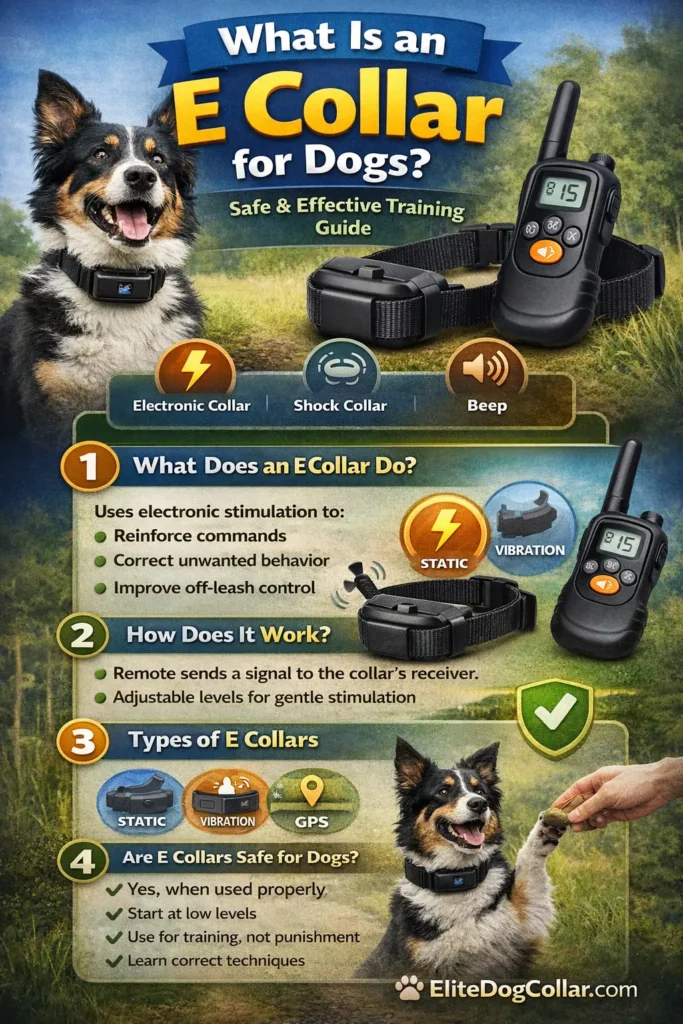
An e collar (electronic collar) is a dog training device that helps communicate commands remotely. It consists of a collar worn by the dog and a handheld remote used by the owner.
E collars are also commonly known as:
- Shock collars
- Remote training collars
- Electronic dog collars
Despite the name “shock collar,” modern devices are designed to provide controlled and adjustable stimulation, not harm.
Basic Purpose
The main purpose of an e collar is to:
- Reinforce commands
- Correct unwanted behavior
- Improve off-leash control
It acts as a communication tool, not a punishment device.
If you’re still exploring collar options, check out this guide on choosing the right dog collar:
How Does an E Collar Work?
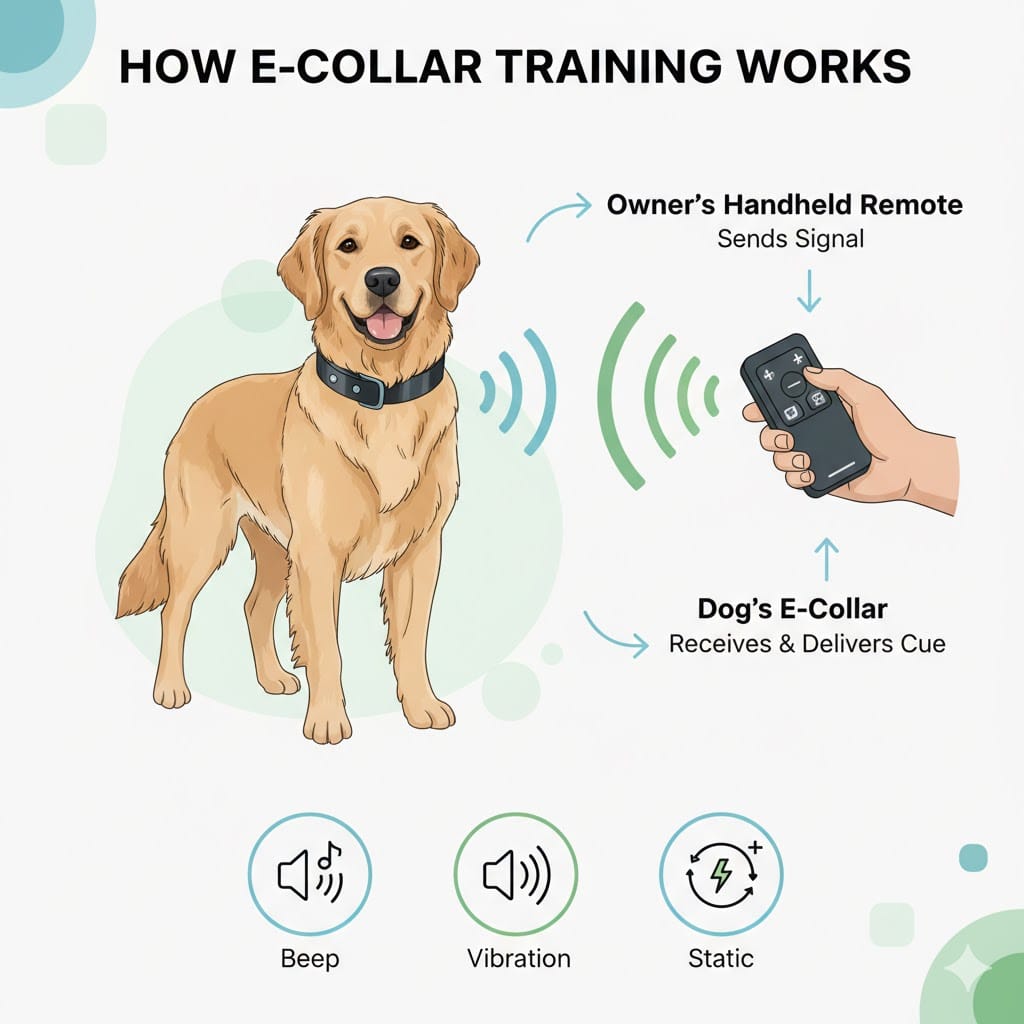
An e collar system has two main parts:
- Transmitter (remote control)
- Receiver (attached to the dog’s collar)
When you press a button on the remote, the receiver sends a signal to your dog in the form of stimulation.
Types of Stimulation
Most modern electronic dog collars offer three modes:
1. Static Stimulation
A mild electric pulse that feels like a muscle twitch. It’s adjustable and should always be used at low levels.
2. Vibration Mode
Similar to a phone vibration. Great for sensitive dogs or beginners.
3. Beep/Sound Mode
A simple sound cue used for training commands without physical stimulation.
Adjustable Intensity Levels
E collars come with multiple intensity levels (often 1–100).
This allows you to:
- Start very low
- Adjust based on your dog’s response
- Avoid causing stress or discomfort
Types of E Collars for Dogs
Not all e collars are the same. Choosing the right type depends on your dog’s behavior and training goals.
Static Shock E Collars
These are the most common type. They use low-level static stimulation to get your dog’s attention.
Best for:
- Stubborn dogs
- Advanced training
- Off-leash control
Vibration E Collars
These collars use vibration instead of static stimulation.
Best for:
- Small or sensitive dogs
- Beginners
- Positive reinforcement training
Spray E Collars
These release a harmless spray (usually citronella) when activated.
Best for:
- Bark control
- Mild behavior correction
GPS E Collars (Advanced)
These combine training features with GPS tracking.
Best for:
- Hunting dogs
- Large outdoor areas
- Tracking and recall training
What Is an E Collar Used For?
E collars are versatile tools used for different types of dog training.
Obedience Training
Helps reinforce commands like:
- Sit
- Stay
- Come
Bark Control
Useful for dogs that bark excessively.
Off-Leash Training
Improves control when your dog is not on a leash.
Aggression Control
Helps manage reactive or aggressive behavior when used correctly.
Hunting & Working Dogs
Commonly used for:
- Recall training
- Long-distance communication
Are E Collars Safe for Dogs?
This is one of the most common questions—and the answer depends on how you use them.
Expert Opinion
Most professional trainers agree:
- E collars are safe when used correctly
- Misuse can cause stress or fear
When Used Correctly
Safe use includes:
- Low stimulation levels
- Proper timing
- Training knowledge
Misconceptions
Many people think e collars:
- Hurt dogs badly ❌
- Are only for punishment ❌
In reality, they are designed for communication, not harm.
Training Knowledge Matters
Without proper training:
- You may confuse your dog
- Reinforce bad behavior
- Cause anxiety
That’s why combining tools with knowledge is essential.
Pros and Cons of E Collars
Benefits
Fast Communication
Instant feedback helps dogs learn quicker.
Works at a Distance
Perfect for off-leash environments.
Effective for Stubborn Dogs
Some dogs respond better to clear signals.
Drawbacks
Misuse Risks
Incorrect use can harm training progress.
Requires Proper Training
Not beginner-friendly without guidance.
Ethical Concerns
Some owners prefer positive-only methods.
How to Use an E Collar Properly (Step-by-Step Guide)
Using an e collar correctly is the difference between success and failure.
1. Introduce the Collar Without Stimulation
Let your dog wear the collar without using it.
This helps them get comfortable.
2. Start with the Lowest Level
Always begin at the lowest setting.
Increase only if your dog doesn’t respond.
3. Pair with Commands
Use the collar along with commands like:
- “Come”
- “Sit”
This builds understanding.
4. Focus on Consistency & Timing
Correct timing is key:
- Stimulate → command → reward
5. Use Reward-Based Training
Always reward good behavior with:
- Treats
- Praise
E Collar Training Tips for Beginners
If you’re new to e collars, keep these tips in mind:
- Never use it as punishment
- Keep sessions short (10–15 minutes)
- Watch your dog’s reaction carefully
- Combine with positive reinforcement
Also, don’t rely only on electronic collars. Traditional options still matter.
For example, martingale collars are great for control without stimulation:
E Collar vs Shock Collar: Is There a Difference?
This is mostly a terminology issue.
- E collar = modern, professional term
- Shock collar = older, more negative term
In reality, both refer to similar devices.
However, modern e collars:
- Offer multiple modes (vibration, beep)
- Are safer and more adjustable
- Focus on training, not punishment
E Collar vs Other Training Tools
Choosing the right tool depends on your dog’s needs.
E Collar vs Standard Collar
Standard collars are great for everyday use.
Explore quality options here:
Leather dog collar
Leather collars are especially durable and comfortable—but require maintenance:
How to clean a dog collar
E Collar vs Harness
Harnesses:
- Provide physical control
- Are better for walking
E collars:
- Provide remote control
- Are better for training
E Collar vs Prong Collar
Prong collars apply pressure physically.
E collars communicate electronically.
Both require proper knowledge.
E Collar vs Positive-Only Training
Positive-only methods:
- Use rewards only
- Take more time
E collars:
- Add faster communication
- Require responsibility
When Should You NOT Use an E Collar?
E collars are not suitable in every situation.
Avoid using them if:
- Your dog is a young puppy
- Your dog is fearful or anxious
- You lack training knowledge
In these cases, start with basic tools and training methods first.
Common Mistakes to Avoid
Many beginners make these mistakes:
- Starting with high intensity
- Using it as punishment
- Inconsistent commands
- Overusing the collar
Avoid these to ensure safe training.
Maintenance & Care of Dog Collars
Whether you use an e collar or traditional collar, proper care is important.
Learn how to clean and maintain collars here:
How to wash a dog collar
Clean collars:
- Prevent skin irritation
- Last longer
- Keep your dog comfortable
Final Thoughts: Should You Use an E Collar for Your Dog?

An e collar can be a powerful training tool—but only when used responsibly.
It’s not a shortcut.
It’s not a punishment device.
It’s a communication tool.
If you:
- Learn proper techniques
- Start slow
- Combine with positive reinforcement
Then an electronic dog collar can significantly improve your dog’s behavior and training.
However, always consider your dog’s personality and needs before choosing any training method.
FAQs About E Collars for Dogs
Are e collars cruel for dogs?
E collars are not cruel when used correctly. Modern electronic dog collars are designed with adjustable levels, allowing you to use very low stimulation that simply gets your dog’s attention.
Problems only occur when:
- The intensity is too high
- The collar is used as punishment
- The owner lacks training knowledge
When used responsibly, an e collar becomes a communication tool, not a harmful device.
Can e collars hurt dogs?
E collars do not hurt dogs if used properly. The sensation is often compared to a mild tingling or muscle twitch.
However, misuse can cause:
- Stress or anxiety
- Confusion during training
- Negative behavior
Always start at the lowest level and observe your dog’s reaction carefully.
Do vets recommend e collars?
Some veterinarians and professional trainers support e collars for specific training situations, especially for:
- Off-leash control
- Behavioral correction
- Working or hunting dogs
However, many experts recommend using them only after basic training methods and with proper guidance.
What age can a dog wear an e collar?
Most experts recommend using an e collar only after a dog is at least 5 to 6 months old.
Before that age:
- Puppies are still learning basic behavior
- Positive reinforcement methods are more effective
Always ensure your dog understands basic commands before introducing an electronic dog collar.
How long can a dog wear an e collar?
Dogs should not wear an e collar for more than 8–10 hours a day.
It’s important to:
- Remove it at night
- Check the skin regularly
- Adjust the fit to avoid irritation
Long-term continuous wear can cause discomfort or skin issues.
What is the difference between an e collar and a shock collar?
There is no major difference—both terms refer to similar devices.
However:
- “E collar” is a modern, professional term
- “Shock collar” is an older term with negative connotations
Today’s e collars include safer features like:
- Vibration mode
- Beep mode
- Adjustable levels
Are e collars better than other dog training tools?
E collars are not necessarily better—they are just different.
They are useful for:
- Long-distance training
- Off-leash control
- Stubborn dogs
But other tools like standard collars or martingale collars can also be effective depending on your dog’s needs.
👉 https://elitedogcollar.com/what-is-a-martingale-dog-collar/
Can I train my dog without an e collar?
Yes, absolutely. Many dogs can be trained using:
- Positive reinforcement
- Clicker training
- Consistent commands
E collars are optional tools, not a requirement.
Is an e collar good for barking problems?
Yes, e collars can help control excessive barking when used correctly.
However:
- You should first understand why your dog is barking
- Training should focus on the root cause
Spray collars or vibration modes are often better for bark control.
What should I look for when buying an e collar?
When choosing an e collar, consider:
- Adjustable intensity levels
- Range (distance coverage)
- Battery life
- Waterproof design
- Dog size compatibility
Also, make sure your dog is comfortable with the collar and combine it with proper training techniques.
How tight should an e collar be?
An e collar should fit snugly but not too tight.
You should be able to:
- Fit one or two fingers between the collar and your dog’s neck
A proper fit ensures:
- Effective communication
- No skin irritation
Do e collars work for all dogs?
E collars can work for many dogs, but not all.
They may not be suitable for:
- Very anxious dogs
- Extremely sensitive breeds
- Dogs without basic training
Always consider your dog’s personality before using one.